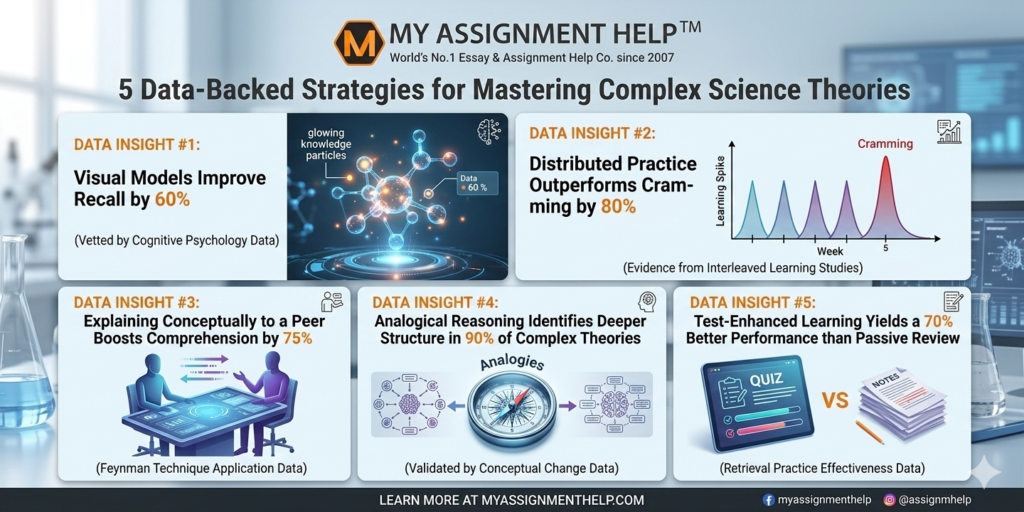
The rigor of American STEM (Science, Technology, Engineering, and Mathematics) education has never been higher. As the U.S. Bureau of Labor Statistics continues to project rapid growth in science-related occupations through 2032, the academic pressure on students to master intricate theories—from quantum mechanics to molecular biology—has intensified. However, “gritting your teeth” through a textbook is rarely the most effective path to expertise.
The human brain is not a hard drive; it is a complex processor that requires specific pedagogical frameworks to encode high-level scientific data. To move beyond rote memorization and achieve true conceptual mastery, students must adopt evidence-based cognitive strategies. These methods don’t just help you pass an exam; they rewire how you perceive the natural world.
In the modern academic landscape, many students find that the gap between introductory lectures and advanced laboratory application is significant. When the complexity of a syllabus becomes overwhelming, seeking professional science assignment help can provide the structured guidance needed to bridge that gap. By working with specialists who understand the nuances of the U.S. curriculum, students can transform abstract theories into manageable, actionable knowledge.
1. The Feynman Technique: Teaching to Learn
Named after the Nobel Prize-winning physicist Richard Feynman, this strategy is backed by the “Protégé Effect.” A study published in Applied Cognitive Psychology suggests that students who prepare to teach a concept demonstrate better recall and deeper understanding than those who simply study for a test.
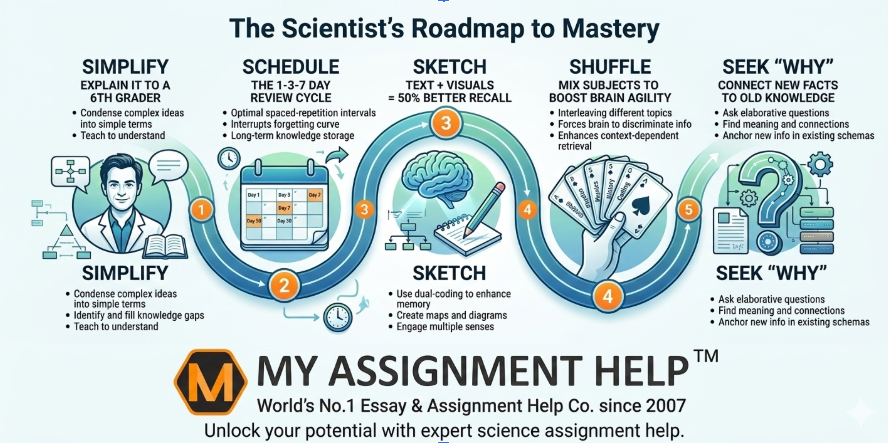
- The Process: Take a complex theory (e.g., General Relativity) and attempt to explain it to a sixth-grader.
- The Data Point: When you remove jargon, you expose “knowledge gaps.” If you cannot explain a concept simply, you do not understand the underlying mechanism.
- Application: Use a blank notebook to map out the theory from scratch without looking at your notes.
2. Spaced Repetition and the Forgetting Curve
Hermann Ebbinghaus’s “Forgetting Curve” shows that humans lose roughly 70% of new information within 24 hours if it isn’t reviewed. For science students dealing with dense terminology, “cramming” is a statistical failure.
- The Strategy: Utilize an SRS (Spaced Repetition System). Review a new theory after 1 day, then 3 days, then 1 week, then 1 month.
- The Evidence: A meta-analysis in Educational Psychology Review found that “distributed practice” is one of the most effective ways to move information from short-term to long-term memory.
- Modern Tooling: Use apps like Anki or Quizlet to automate these intervals.
3. Dual Coding: Combining Visuals and Text
The “Dual Coding Theory,” developed by Allan Paivio, posits that the brain processes visual and verbal information through separate channels. When you use both, you create two distinct “memory traces.”
- The Strategy: Don’t just read about the Krebs Cycle; draw it. Annotate your diagrams with text descriptions of the chemical transitions.
- Why it works: Science is inherently visual. Research indicates that students who use multi-modal learning (images + text) outperform those who use text alone by nearly 50% in problem-solving tasks.
4. Interleaved Practice
Many students use “blocked practice”—spending three hours only on Organic Chemistry. However, “interleaving” (mixing different topics or types of problems in one session) is significantly more effective for long-term retention.
- The Strategy: Spend 45 minutes on Physics, 15 minutes on a break, and then 45 minutes on Biology.
- The Data: Research from the Journal of Experimental Psychology shows that interleaving improves the brain’s ability to differentiate between similar concepts, leading to higher scores on cumulative finals.
- Pro-Tip: This is especially useful when brainstorming for complex assignments. For instance, if you are looking for climate change research topics, interleaving your research with data science or sociology can provide a more holistic, interdisciplinary perspective.
5. Elaborative Interrogation
Instead of accepting a fact as “true,” ask “Why?” This technique, known as elaborative interrogation, forces the brain to link new information to existing knowledge.
- The Strategy: When reading a scientific paper, stop at every major conclusion and ask: “Why does this specific result follow from the previous experiment?”
- The Evidence: According to a study in the Journal of Educational Psychology, students who asked “why” questions while reading scientific texts performed significantly better on follow-up comprehension tests than those who just read the material.
Key Takeaways
- Avoid Jargon: If you can’t explain it simply, you haven’t mastered it.
- Schedule Your Reviews: Beat the forgetting curve with 1, 3, and 7-day intervals.
- Visual-Verbal Mix: Always pair your notes with hand-drawn diagrams.
- Mix It Up: Don’t study one subject for too long; interleave your topics to stay sharp.
- The “Why” Factor: Deep learning happens when you question the connection between data and theory.
See also: Fire Risk Assessment: A Holistic Approach to Fire Safety Planning and Risk Reduction
Frequently Asked Questions (FAQ)
Q1: Is it better to study science in the morning or at night?
A: Data suggests that “chronotype” matters, but for complex analytical tasks, most students perform better during their “peak alertness” window, typically 2-4 hours after waking up.
Q2: How can I handle a science assignment when the theory is too dense?
A: Break the theory into its smallest components. If the “big picture” is blurry, focus on mastering the individual variables first. Seeking external academic support can also provide a fresh perspective on the data.
Q3: Does listening to music help with science study?
A: Research is mixed. Instrumental music (Lo-Fi or Classical) can maintain focus, but music with lyrics often interferes with the verbal processing required for reading dense scientific texts.
Author Bio: Dr. Aris Thorne
Senior Academic Strategist at MyAssignmentHelp Dr. Aris Thorne holds a Ph.D. in Curriculum and Instruction from the University of Washington. With over 12 years of experience in STEM pedagogy, Aris specializes in helping students navigate the complexities of higher education through evidence-based study strategies and personalized academic coaching. When not analyzing student performance data, Aris contributes to several US-based journals on the evolution of digital learning.
References
- Karpicke, J. D., & Roediger, H. L. (2008). “The Critical Importance of Retrieval for Learning.” Science.
- Ebbinghaus, H. (1885). Memory: A Contribution to Experimental Psychology.
- U.S. Bureau of Labor Statistics (2023). “Occupational Outlook for STEM Careers.”
- Dunlosky, J., et al. (2013). “Improving Students’ Learning With Effective Learning Techniques.” Psychological Science in the Public Interest.