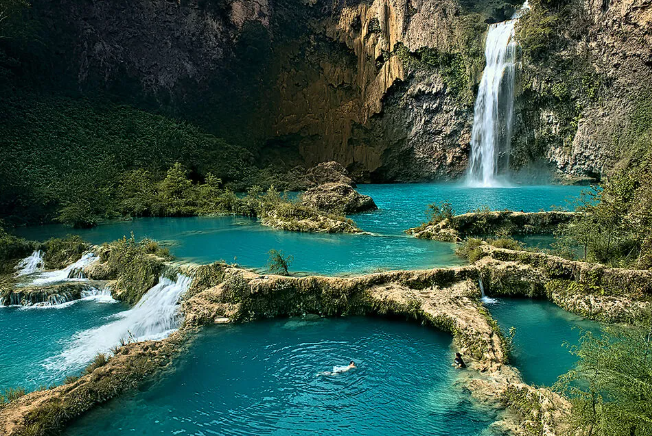
I flew into San Luis Potosí on a Tuesday in late October, paying $168 return from Tampa with a single connection in Houston. The next eight days I spent swimming. That price did not arrive because I bought on a Tuesday, since the day you purchase has no bearing on what you pay, and nor did a private window and cleared cookies have anything to do with it. It arrived because I booked on 9 August, roughly eleven weeks before departure, on a route where the low-cost and legacy carriers overlap enough to keep each other honest. I am sixty-three, I have a hip that complains on stairs, and I have reached the stage of life where a 5am airport run to save twenty euros is a trade I decline without a second thought. Simple as that.
The state has two entirely separate swimming geographies, and conflating them is the first mistake people make. Around Xilitla and the Huasteca Potosina you have the cascade country: Tamul, Minas Viejas, Micos, El Meco, all of it fed by the Tampaón and its tributaries, and cold enough in February to make your jaw ache. Near the capital you have the thermal pools at Taninul and the springs around Media Luna. They sit at a bath-warm 28°C year round. No rope, no guide, no nerve.
Booking early comes down to one thing: capacity into the Huasteca in the December to Easter window. There are four daily departures from San Luis Potosí city to Ciudad Valles on the better regional operators, each seating around forty. That is 160 seats a day serving a region that pulls thousands of visitors once the northern hemisphere winter bites. I priced a 3 December departure in September at 1,890 pesos return. By mid-November the same seats were 3,240 pesos, and the 9am and 11am runs were gone. Two rooms I liked in Xilitla, at 1,150 pesos a night with breakfast, were fully committed by 20 October. If your dates are fixed and your dates fall in that window, early is not a strategy, it is the only option.
See also: What are cross-border payments? How B2B businesses can use Payoneer for global transactions
Staying flexible is the half agents leave off the quote. January and February are dry, the water is at its clearest, and daytime highs around Xilitla sit near 26°C while the nights drop to 11°C, which is pleasant for walking and miserable for swimming before ten in the morning. September and October are the greenest months and the emptiest, with the same pools running at perhaps a third of the visitor numbers. The rain arrives most afternoons, though, and the rivers can turn chocolate brown for two or three days after a heavy night. Between them sits the trade: I paid 1,240 pesos for a room in October that costs 1,900 in January, and I swam every single day, just not always where I had planned. Four things settle the money for me, in this order:
- Whether the fare allows a date change, and what that change costs
- The cancellation terms on the accommodation, not the deposit percentage
- Whether the operator runs daily in your month or only on weekends
- The realistic connection time, not the airline’s minimum
Somewhere in the middle of planning I usually end up comparing the whole trip against a flight to guadalajara, because Guadalajara puts you within reach of the coast and the fares out of the American south are frequently lower. Flying into Guadalajara and driving four hours east to the Huasteca is a genuine alternative, and if you are travelling with three other people and splitting a rental car, it beats flying into San Luis Potosí outright. Alone, or as a pair, the arithmetic flips: the rental runs about 900 pesos a day plus fuel and tolls on the 57D, and the bus from the capital to Ciudad Valles costs 480 pesos with a reclining seat and legroom I cannot get on any aircraft.
A school calendar, a wedding, an anniversary — someone else’s date on your booking decides everything. When that is the case you book the moment the schedule opens and you pay whatever it costs. When it is not, you wait for a Tuesday in October and swim alone.