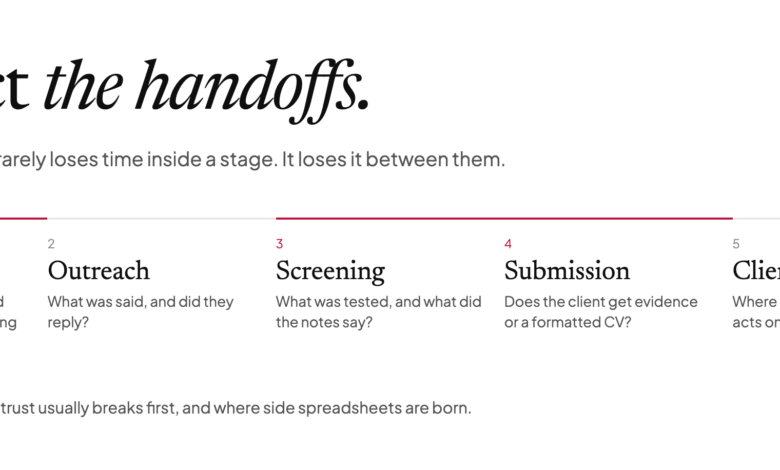
A staffing business can have thousands of candidate records and still lose time every day. One recruiter finds a person, another contacts the same candidate, a client receives a resume without enough context, and the team later searches through email to work out what happened. The real value of staffing agency software is not the size of the database. It is whether the system protects the handoffs between sourcing, outreach, screening, submission, and client feedback.
Agency recruiting is different from hiring inside one company. The same candidate may suit several clients, several recruiters may work related roles, and another agency may be speaking to the same person.
Protect the handoffs: sourcing to outreach to screening to submission to client feedback, with the points where trust usually breaks marked on the chain.
Start With the Point Where Trust Breaks
Before buying another tool, agency leaders should identify where recruiters stop trusting the existing process. It might be candidate ownership, duplicate records, incomplete contact history, missing interview notes, or unclear client feedback. Those problems often lead people to build side systems in spreadsheets and private messages.
Once that happens, the official database becomes less useful. Recruiters update it late, managers see an incomplete picture, and disputes take longer to resolve. Technology should reduce the need for side channels. Sourcing is a good place to look first, because it is where duplicates are born: a sourcing tool that keeps everyone found for a job order in that order’s pool, excludes them from every later search on it, and records who kept or passed on each person removes the most common cause of two recruiters calling the same candidate.
Candidate Supply Is Only Half the Problem
Sourcing tools can help agencies widen their reach, especially for specialist or hard-to-fill roles. But a larger pool does not automatically produce more placements. Recruiters still need to know which candidates are worth contacting and which are strong enough to submit.
That is why agencies should measure the journey from discovered candidate to credible shortlist, not just the number of profiles found. A team that sources 500 people but submits 5 weak candidates may be less effective than a team that sources 100 and sends 3 well-evaluated people to the client. Candidate sourcing that ranks the agency’s own database and the outside market against the same job order, with a reason attached to each match, is what makes the second team possible.
Client Submissions Need Evidence
A resume gives a client a career history, but it may not answer the questions that decide whether someone should move forward. Agencies can improve the handoff by adding structured notes, relevant interview evidence, availability, motivation, and any concerns that emerged during screening.
This is also a useful way to evaluate the best ai recruiting tools. Instead of asking how much activity a platform can automate, ask what the client receives at the end. Does the software help recruiters understand why a candidate fits? Can the agency review the evidence behind an assessment? Does it reduce the amount of screening the client has to repeat? A first-round interview run by the platform and scored against a fixed rubric, with the transcript behind each score, is the most direct answer to that last question: the client reads a scored summary rather than a formatted CV.
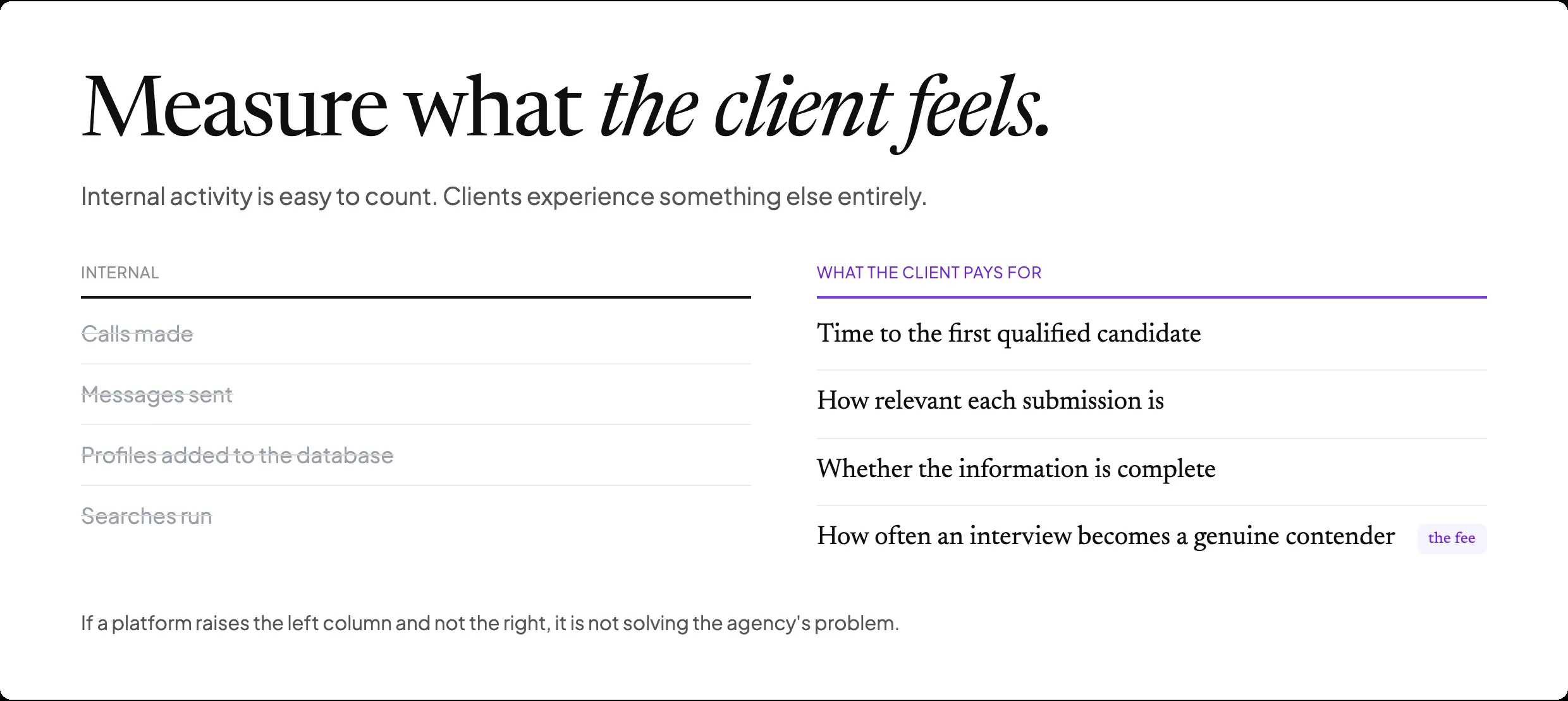
Measure what the client feels: calls made and messages sent are internal; time to first qualified candidate, submission relevance, completeness and interview-to-contender rate are what the client pays for.
Do Not Force One Tool to Do Every Job
Many agencies already have an ATS or recruitment CRM that manages jobs, candidate records, submissions, compliance, and commercial activity. A new AI or sourcing product does not necessarily need to replace that system. In many cases, the better question is whether the tools can work together without forcing recruiters to copy information manually.
The operating system should remain the trusted record of the agency’s activity. Specialist tools can then support areas such as sourcing, contact enrichment, interviewing, or analysis. Integration matters because a useful feature quickly becomes unpopular if recruiters have to re-enter the same data in 3 places. Whether the record is a recruiting CRM, Bullhorn, or another ATS, the test of any addition to the recruiting software for staffing firms stack is whether every stage change writes back to it in both directions.
Speed Should Improve Quality, Not Lower the Bar
Agency clients often want candidates quickly, but speed becomes expensive when it creates rework. Sending a resume before basic questions are answered may win a few hours and lose several days later. A reliable evaluation process should match faster sourcing.
In high-volume staffing, structured screening criteria can also stop teams from changing the bar halfway through a search.
Measure the Workflow the Client Actually Feels
Internal metrics such as calls made or messages sent can be useful, but clients experience different outcomes. They notice how quickly the first qualified candidate arrives, how relevant submissions are, whether information is complete, and how often interviews turn into genuine contenders.
Those measures are closer to the value an agency sells. Software should help improve them or make them easier to understand. If a new platform increases activity but creates more duplicate work, more weak submissions, or more confusion about ownership, it is not solving the agency’s real problem.
I run The Cognitive, and for agencies our platform covers the front of that chain: sourcing that ranks the database and the market against the job order and excludes people already found, outreach in the consultant’s name that stops on reply, and a first-round interview that produces the evidence a submission needs, written back to the agency’s ATS. Take that as one vendor’s account of what staffing recruitment software can now do, and put it through the tests in this article as hard as any other.
Conclusion
The right technology stack depends on where an agency is losing time or confidence. A team short of candidates needs better sourcing. A team with plenty of applicants but slow screening needs better evaluation. An agency struggling with ownership and submissions needs stronger process control.
The best systems make the path from first discovery to client handoff easier to follow. They give recruiters better information without removing their judgment. For staffing agencies, that is usually more valuable than simply adding another large database to search.
Sparsh Goyal is the founder of The Cognitive, the AI recruiting platform that finds candidates across ~900M profiles, reaches them with verified contact details, and interviews them in live two-way conversations, so the hiring team meets a shortlist that has already been proven.