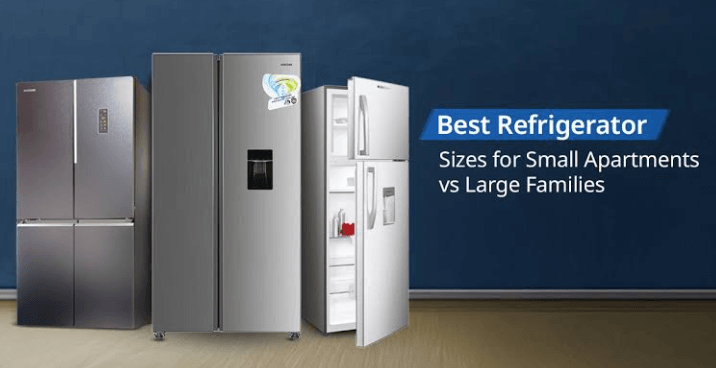
Choosing the refrigerator is not all about design and affordability, there is another factor besides all these factors to take into account, and it is space that will accommodate all your groceries, drinks, fresh and frozen items without making your kitchen look like a mess. The Best Refrigerator for you needs to be selected keeping in mind the family, consumption, space and budget.
1. Start With Household Size
The size of the household provides a good place to start. One or two people might be able to cope with a small unit, whereas bigger households will require more space.
| Household Size | Suggested Capacity |
| 1–2 people | 4–8 cubic feet |
| 3–4 people | 9–14 cubic feet |
| 5–6 people | 15–20 cubic feet |
| 7 or more people | 20+ cubic feet |
This is just a guide and does not constitute a hard and fast rule. You will have other factors that influence how much you require, such as how often you go shopping and cook.
2. Match Capacity to Your Food Habits
Think of what you normally stock in the refrigerator. If you buy groceries every couple of days and make meals regularly, then a small refrigerator is suitable for you. But if you buy groceries for a whole week, make meals in advance, or store big pans, then you will require some extra space.
It will help if you think of the things that you regularly stock like bottles of milk, vegetables, leftovers, and drinks. You may consider adjustable shelves and racks in the doors of the fridge.
3. Compare Refrigerator Styles
Space is used differently in each design, so it will be wise to think about how you would like to arrange your food items.
The single door design is compact and tends to work better with individuals or couples.
The double door design has the freezer and the fresh food section separated.
Side-by-side refrigerators place the refrigerator and the freezer side by side. Both are accessible from either side but it is important to take into account their sizes and how the doors open.
The French door refrigerators have two doors on top and the drawer freezer below. The large shelves can hold the trays and large containers.
You should not estimate the volume by looks only. Always take into consideration their volume and interior layout.
4. Measure the Installation Area
Measure the available space in terms of height, width, and depth where the fridge is supposed to be installed. Measure the fridge’s dimensions, as well as any extensions like handles and others. The instructions given by the manufacturer on how much clearance should be left around the sides, behind, and above the fridge to allow ventilation.
Also, measure the path from the entrance to the kitchen. It might be hard to deliver a fridge through door frames, hallways, staircases, and tight turns. Make sure there is enough room to open the doors without hitting the wall, cabinets, and kitchen island.
5. Decide How Much Freezer Space You Need
The size of the freezer is essential for those storing meat, vegetables, prepared meals, or seasonal products. People purchasing meat in large amounts may require more freezer space than those only keeping ice and a limited amount of frozen foods.
In addition to capacity, pay attention to shelves, drawers, and compartments. It’s helpful if the freezer is organized in order to separate foods and quickly access the items.
6. Consider Energy Use
The refrigerator works daily, thus electricity consumption will influence the cost of using it. Factors influencing the usage of electricity include efficiency, insulation, setting temperatures, room temperatures, and door opening frequency. Large refrigerators may differ in electricity consumption, hence the need to consider energy requirements of each.
Take into account usage costs in addition to buying costs. In Pakistan, where electricity bills can be a huge household cost, efficiency matters. It is important to follow the manufacturer’s instructions concerning the setting of temperature and room ventilation.
7. Set a Realistic Budget
After determining your size requirements and configuration preferences, you can proceed with comparing various appliances within your budget range. It is better to concentrate on such factors as capacity, warranty, cooling system, shelves, energy details, etc., rather than on price alone.
It is better not to choose an appliance that is either too big or too small since both variants can bring problems to you. Too small an appliance won’t provide sufficient space for all your purchases while the oversized one can cost too much.
See also: What are cross-border payments? How B2B businesses can use Payoneer for global transactions
Conclusion
The refrigerator size is contingent upon your family’s requirements, storage preferences, the dimensions of your kitchen, your freezer requirements, and expenses. Looking into all these aspects before making a purchase will enable you to choose a practical refrigerator without making any typical errors. Think about your requirements and not just opt for a model that appears spacious or has more features than your requirements. Visit Electromart and check out the dimensions of the different models and make your choice. The Best Refrigerator is one that meets all your requirements.